To learn how HANS works, please watch the tutorial on our technology page.
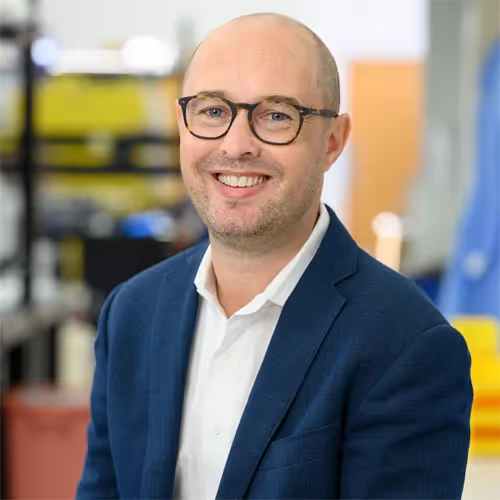
Dr. Bready has served as CEO of NABsys since 2005. He led the acquisition of GeneSpectrum as well as the execution of the licensing deal with Brown University. Since joining NABsys, Barrett has been named one of the top "30 under 30" in New England by Mass High Tech: The Journal of New England Technology and one of "25 movers and shakers" in Rhode Island by the magazine Rhode Island Monthly. Barrett teaches "Biotechnology Management" at Brown University where he holds the position of Adjunct Assistant Professor of Biotechnology. Dr. Bready received his M.D. from Brown Medical School and his Sc.B. in physics from Brown University, both as part of Brown's eight-year Program in Liberal Medical Education. Dr. Bready serves on the Board of Directors of the Brown Medical Alumni Association and on the Board of Trustees of the Providence Preservation Society.
John Oliver joined NABsys Inc. in March of 2007 as Vice President of Research and Development. Prior to joining NABsys, Dr. Oliver was Chief Scientific Officer and Co-Founder at GeneSpectrum, a biotechnology company developing patterned probes for application to sequencing by hybridization. Prior to his work at GeneSpectrum, Dr. Oliver was Assistant Professor of Chemistry at Brown University. He received his doctorate degree in chemistry from Northwestern University and his bachelors of science in chemistry from Harvey Mudd College.
Dr. Ling is Associate Professor of Physics at Brown University and a NABsys founder. Professor Ling joined the faculty of Brown University in 1996. A 1984 graduate of Wuhan University, China, he received his M.S. from the Chinese Academy of Sciences in 1987 and his Ph.D. from the University of Connecticut in 1992. He has done postdoctoral research at Yale University and the NEC Research Institute at Princeton from 1992-1996. Most recently he was a visiting professor at Delft University of Technology in the Netherlands from 2002-2003 and a guest professor at Wuhan University from 2002-2005. Professor Ling received a Research Innovation Award from the Research Corporation in 1998, and he was an A.P. Sloan Fellow from 1998-2001 and a J.S. Guggenheim Fellow from 2002-2003. He was elected a Fellow of the American Physical Society in 2005.
Dr. Petrossian joined NABsys Inc. in April of 2008 as Director of Nanofabrication. Prior to joining NABsys, Dr. Petrossian was a product engineer at KLA-Tencor, a company developing next generation defect detection tools for the semiconductor industry. Dr. Petrossian recently completed his doctoral degree at the Arizona State University where his research focused on biological applications of nanopores fabricated in a semiconductor substrates. He received his doctorate and masters degrees from Arizona State University in electrical engineering and his bachelors of science in biomedical engineering and in electrical engineering from the California State University at Long Beach.
Since 1974, Dr. Cooper has been the Thomas J. Watson, Sr. Professor of Science at Brown University. He is also the director of the Brown University Institute for Brain and Neural Systems. Professor Cooper has received many forms of recognition for his work including, in 1972, the Nobel Prize in Physics (with J. Bardeen and J.R. Schrieffer) for his studies on the theory of superconductivity. In 1968, he was awarded the Comstock Prize (with J.R. Schrieffer) of the National Academy of Sciences. He is a fellow of the American Physical Society and American Academy of Arts and Sciences and a member of the American Philosophical Society, the National Academy of Sciences, the Society of Neuroscience, and the American Association for the Advancement of Science. Professor Cooper is Co-founder and was Co-chairman of Nestor, Inc., a company applying neural-network systems to commercial and military applications. He was also Co-founder and Chairman of Sention, a pharmaceutical development company focused on the discovery and development of drugs for the treatment of disorders related to higher brain functions such as learning and memory. Dr. Cooper received his A.B., A.M., and Ph.D. degrees from Columbia University. He holds seven honorary doctorates.
Mr. Horan has served as the Senior Managing Director of the Slater Technology Fund since 2005. From 2002-2005, Mr. Horan served as the Executive Director of the Slater Center for Biomedical Technologies. In 1986, Mr. Horan joined the venture capital firm of Johnston Associates in Princeton, NJ, one of the original seed stage investors in the field of biotechnology and life sciences. In 1998, Mr. Horan founded Sachem Ventures LLC, an independent seed stage venture development firm which focused in life science and healthcare markets. During his tenure in the venture capital business, Mr. Horan has served as CEO of several of the portfolio companies in which his firms have invested, including: Immunicon Corp. (NASDAQ: IMMC), Praelux Corp. (acquired by GE Amersham), and Medical Metrix Inc. (currently venture-backed). Mr. Horan received his A.B. from Dartmouth College and an M.B.A. from the Tuck School at Dartmouth.
Franco P. Preparata has been the An Wang Professor of Computer Science at Brown University since January 1991. Formerly, he was a Professor of Electrical Engineering and of Computer Science at the University of Illinois at Urbana-Champaign. Prior to joining the faculty at the University of Illinois, he worked in industry at Sperry Rand Univac and Selenia, a subsidiary of Raytheon. He began his research activity in switching and coding theory. In this field he discovered a class of optimal burst-correcting codes (the Berlekamp-Preparata codes) and the first known class of optimum nonlinear codes known as Preparata codes. He also contributed to a classical model for fault diagnosis in digital systems, commonly referred to as the Preparata-Metze-Chien model. Gradually his interests evolved towards the design and analysis of computer algorithms, and he has carried out research in this field for the past eighteen years. His major focus is currently computational biology. He has published nearly 200 papers in these fields and is the author (or co-author) of three textbooks. He is co-author on three patents pertaining to sequencing by hybridization and co-founded GeneSpectrum, Inc. to commercialize a related sequencing technology.
Dr. Upfal is the Chair of the Computer Science Department at Brown University. Prior to joining the faculty at Brown, he was a researcher and project manager at the IBM Almaden Research Center in California and a professor at the Weizmann Institute in Israel. Dr. Upfal's general research area is theory of computation-trying to apply rigorous mathematical tools to the design and analysis of computer algorithms. He is particularly interested in applications of probability theory and combinatorics to this area. He is co-author on three patents pertaining to sequencing by hybridization and co-founded GeneSpectrum, Inc. to commercialize a related sequencing technology.
Dr. Chu is currently the Director of Lawrence Berkeley National Laboratory and Professor of Physics and Professor of Molecular and Cellular Biology at the University of California, Berkeley. He previously was a Professor of Physics and Applied Physics at Stanford University. Prior to his work at Stanford, Dr. Chu spent many years at Bell Laboratories as the Head of the Quantum Electronics Department. His development of methods to cool and trap atoms with laser light led to the 1997 Nobel Prize in Physics. At Stanford, he helped start Bio-X, a multi-disciplinary initiative linking the physical and biological sciences with engineering and medicine. He is a member of the National Academy of Sciences, the American Philosophical Society, the American Academy of Arts and Sciences, the Academia Sinica, and a foreign member of the Chinese Academy of Sciences and the Korean Academy of Science and Engineering. He serves on the Boards of the Hewlett Foundation, the University of Rochester, NVIDIA, and the scientific boards of the Moore Foundation, NABsys and Helicos. Professor Chu received A.B. and B.S. degrees in mathematics and physics from the University of Rochester, a Ph.D. in physics from UC Berkeley, and eight honorary degrees.
Dr. Austin has been a full Professor of Physics at Princeton University since 1989. He is a Fellow of the American Physical Society, a Fellow of the American Association for the Advancement of Science, and was elected a member of the National Academy of Sciences USA. He has a wide-ranging set of interests in the field of biological physics. His work uses nanotechnology to probe DNA dynamics and DNA-protein interactions.
Dr. Dekker is Professor of Molecular Biophysics at Delft University of Technology. His research centers around the use of the tools of nanotechnology, including nanopores, to study single biomolecules. Dr. Dekker has over 150 publications, including 20 in Science or Nature. From 1999-2000, he was the Antoni van Leeuwenhoek full professor at Delft University of Technology. He is a Fellow of the American Physical Society and a member of the Royal Netherlands Academy of Arts and Sciences.
Dr. Chaikin is Professor of Physics at New York University, a position he held previously at Princeton University and the University of Pennsylvania. He has over 300 publications in peer-reviewed journals. His research interests include both soft and hard condensed matter physics. He is a member of the National Academy of Sciences. Dr. Chaikin did his undergraduate work at Caltech and his graduate work at the University of Pennsylvania.