
Closing the Genomic Integrity Gap in Cell and Gene Therapy Research
The rapid maturation of cell and gene therapies (CGT) marks one of the most transformative shifts in modern biology. Driven by advances in molecular biology, genome engineering, and manufacturing capabilities, the CGT research landscape has expanded at an unprecedented pace—with market estimates exceeding $13 billion in 2025 and projections approaching $200 billion by 2034. As this pipeline grows, so too does the urgency of the scientific questions surrounding it. Chief among them is genomic integrity.
Unlike traditional small-molecule approaches, CGT development involves living systems that are expanded, edited, and processed through manufacturing workflows. Each step in this process—from initial cell line selection to genetic modification, expansion, and final formulation—introduces opportunities for genomic perturbation. These perturbations can manifest as point mutations, copy number variations, structural rearrangements, or chromosomal abnormalities, any of which may have significant consequences for product quality and research outcomes.
The field has learned this lesson directly. Early gene therapy research showed that insertional mutagenesis and unintended genomic alterations can introduce serious safety risks, driving field-wide recognition that comprehensive genomic characterization is not optional—it’s essential. Today, regulatory agencies and CGT developers alike emphasize the need to evaluate genomic stability at multiple stages of product development. Ensuring that research and development objectives are not undermined by unintended genomic risk is a challenge your organization cannot afford to ignore.
Where Today’s Tools Fall Short
Current approaches to genomic integrity assessment rely on a combination of complementary technologies, each offering distinct strengths and real limitations. Karyotyping remains one of the most established methods, enabling visualization of whole chromosomes and detection of large-scale structural abnormalities typically greater than 5 Mb. While highly informative for gross chromosomal changes, its resolution is limited for smaller events, and it is inherently low-throughput and operator-dependent.
Chromosomal microarray analysis (CMA) provides improved resolution, detecting unbalanced copy number variations down to approximately 50 kb. By leveraging hybridization-based probe systems, CMA enables genome-wide assessment of gains and losses. However, it cannot detect balanced structural variants (SVs) such as inversions or translocations—which may still have significant functional consequences.
Short-read next-generation sequencing (NGS) has further advanced the field by enabling high-resolution detection of single-nucleotide variants and small insertions or deletions. With its scalability and relatively low cost, short-read NGS has become a cornerstone of genomic analysis. Yet its reliance on short DNA fragments limits its ability to resolve complex SVs and repetitive genomic regions, leaving important gaps in characterization.
Even used in combination, these traditional methods do not fully capture the spectrum of genomic alterations that may arise during CGT development. As workflows incorporate increasingly sophisticated genome-editing tools—including CRISPR-based systems and engineered viral vectors—the need for more comprehensive, high-resolution, and scalable solutions becomes increasingly clear.
A Regulatory Framework That Acknowledges the Gaps
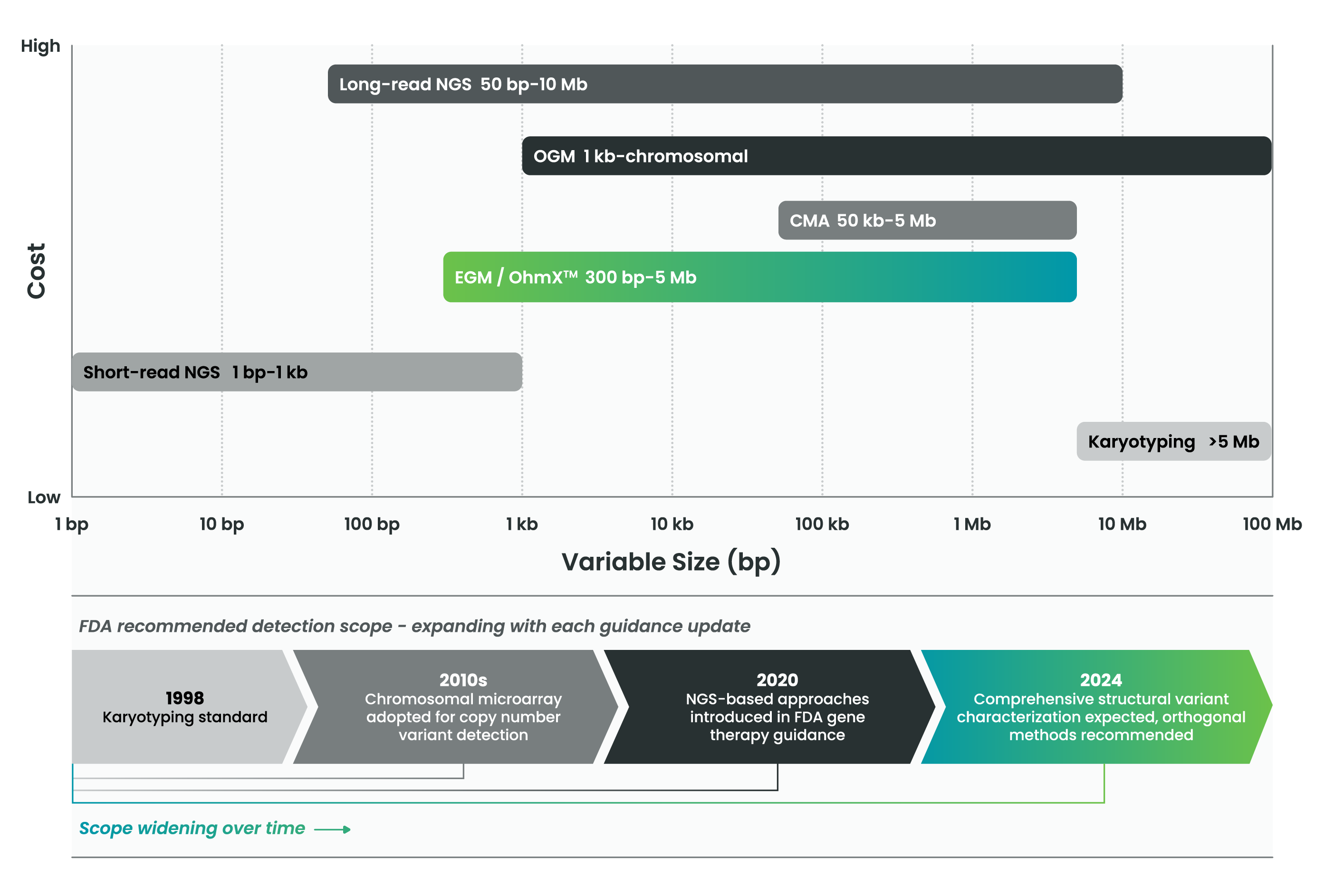
Regulators are beginning to take notice of the gaps. The regulatory direction has been building for decades—from karyotyping as the standard for cell substrate characterization under ICH Q5D (the International Council for Harmonisation guideline finalized in 1998), through the adoption of CMA for copy number variant detection, to the introduction of NGS-based approaches in the FDA's 2020 Chemistry, Manufacturing, and Controls (CMC) guidance for gene therapy development. Most recently, in April 2026, the FDA issued draft guidance on the safety assessment of genome editing in human gene therapy products using NGS.1 The guidance explicitly differentiates between short-read and long-read sequencing strategies, acknowledging that evaluating longer stretches of sequence and larger SVs may require approaches beyond standard short-read methods. For genome editing techniques known to cause double-strand breaks in DNA, the guidance calls for sensitive, quantitative assessment of genomic integrity, including evaluation of chromosomal translocations and large structural events.
This regulatory direction reinforces what many in the field have already concluded: short-read NGS alone is insufficient for comprehensive SV characterization. Orthogonal confirmation using complementary technologies isn’t just good practice—it’s becoming an expectation.
How EGM Fills the Gap
Emerging technologies are beginning to address these limitations and redefine the landscape of genomic integrity assessment. Long-read sequencing platforms, for example, offer read lengths exceeding 10 kb, enabling more contiguous genome assembly and improved detection of SVs. These technologies bridge some of the gaps left by short-read NGS, particularly in repetitive or complex genomic regions. However, challenges remain, including higher costs, lower throughput in some implementations, and variable sensitivity for certain classes of large-scale rearrangements.
Genome mapping technologies represent another promising category. Approaches such as optical genome mapping (OGM) are used to analyze ultra-long DNA molecules to generate high-resolution maps of genomic structure, enabling detection of large SVs, complex rearrangements, and genome-wide architecture changes that are often missed by sequencing-based methods.
Electronic genome mapping (EGM) builds on this concept using solid-state nanochannels and electronic detection rather than optical sensors—an approach that is not subject to the resolution limits of light diffraction. Researchers can use EGM to characterize SVs across a size range of 300 bp to several Mb in a single assay, with turnaround times and cost profiles compatible with routine use in development pipelines.
The integration of these next-generation tools into genomic integrity workflows represents a meaningful shift in how CGT research teams can approach characterization. Rather than relying on a patchwork of partially overlapping methods, researchers can now adopt more unified strategies that provide both breadth and depth of genomic insight. Combining sequencing-based approaches with genome mapping technologies, for example, allows for the detection of single-nucleotide changes, copy number variations, and large structural events within a single analytical framework.
A recent publication in Cytotherapy demonstrates this complementarity in practice. Hulspas et al. (2025) developed a GMP-compliant manufacturing workflow for T cell-derived induced pluripotent stem cells (iPSCs), yielding 13 unique iPSC lines from healthy donor peripheral blood.2 Gene deletions identified across those lines were studied using EGM on the OhmX™ Platform—providing orthogonal confirmation of genomic findings during manufacturing process development. The paper is a practical example of what EGM-based orthogonal confirmation can bring to a CGT workflow where confidence in genomic integrity is non-negotiable.
Building Genomic Confidence in Your CGT Workflow
As the CGT field continues to evolve, the expectations for safety and stability assessment will only increase. Regulatory guidance is likely to become more stringent, requiring deeper characterization and more comprehensive documentation of genomic stability. In parallel, the competitive landscape will favor organizations that can demonstrate robust, scalable, and cost-effective quality control processes.
Technologies such as EGM are well-positioned to play a central role in this future. But EGM won’t be the only tool in your workflow—it will complement the ones you're already familiar with. Where short-read NGS characterizes point mutations and small indels, and karyotyping provides a chromosomal-level overview, EGM closes the critical resolution gap in between: the large, complex structural events that are easiest to miss.
The industry is moving toward a future where comprehensive genomic characterization is both achievable and routine. As these approaches continue to mature, researchers can approach their work with greater confidence in the genomic integrity of their materials, supported by products. improvements in automation, throughput, and data analysis.
To see how EGM was used as an orthogonal confirmation tool in a real CGT manufacturing workflow, read the Hulspas et al. publication or explore the CGT application page.
Citations
1. U.S. Food and Drug Administration. Safety Assessment of Genome Editing in Human Gene Therapy Products Using Next-Generation Sequencing: Draft Guidance for Industry. U.S. Department of Health and Human Services; 2026. Accessed June 22, 2026. https://www.fda.gov/regulatory-information/search-fda-guidance-documents/safety-assessment-genome-editing-human-gene-therapy-products-using-next-generation-sequencing
2. Hulspas R, Sasso C, Cunningham A, Cancelas JA, Daheron LM, Ritz J. Development of a practical GMP-compliant manufacturing process for T cell-derived induced pluripotent stem cells. Cytotherapy. 2026;28(4):102036. doi:10.1016/j.jcyt.2025.102036