
Nabsys Navigator™
Map the Genome
.png)
Analysis Without the Overhead
Nabsys Navigator is the cloud software behind the OhmX Platform. It powers whole-genome variant discovery and variant verification through a suite of advanced informatics pipelines, with minimal bioinformatics expertise required.

Simple
A web interface, minimal bioinformatics expertise.

Secure
Built on Google Cloud with enterprise security controls.

Affordable
No servers to buy, no infrastructure to maintain.

Fast
Results in a few hours, many samples at once.
Identify
De novo assembly, SV calling, and orthogonal confirmation of NGS and long-read data.

View
Explore genome-wide maps and SV calls in an interactive browser, down to 300 bp.
Results
Summarize findings and export shareable outputs for your team or a publication.

Discover or Verify in the Same Place
Nabsys Navigator supports multiple modes of structural variant (SV) analysis, so one environment covers the whole question.
SV-Discover™
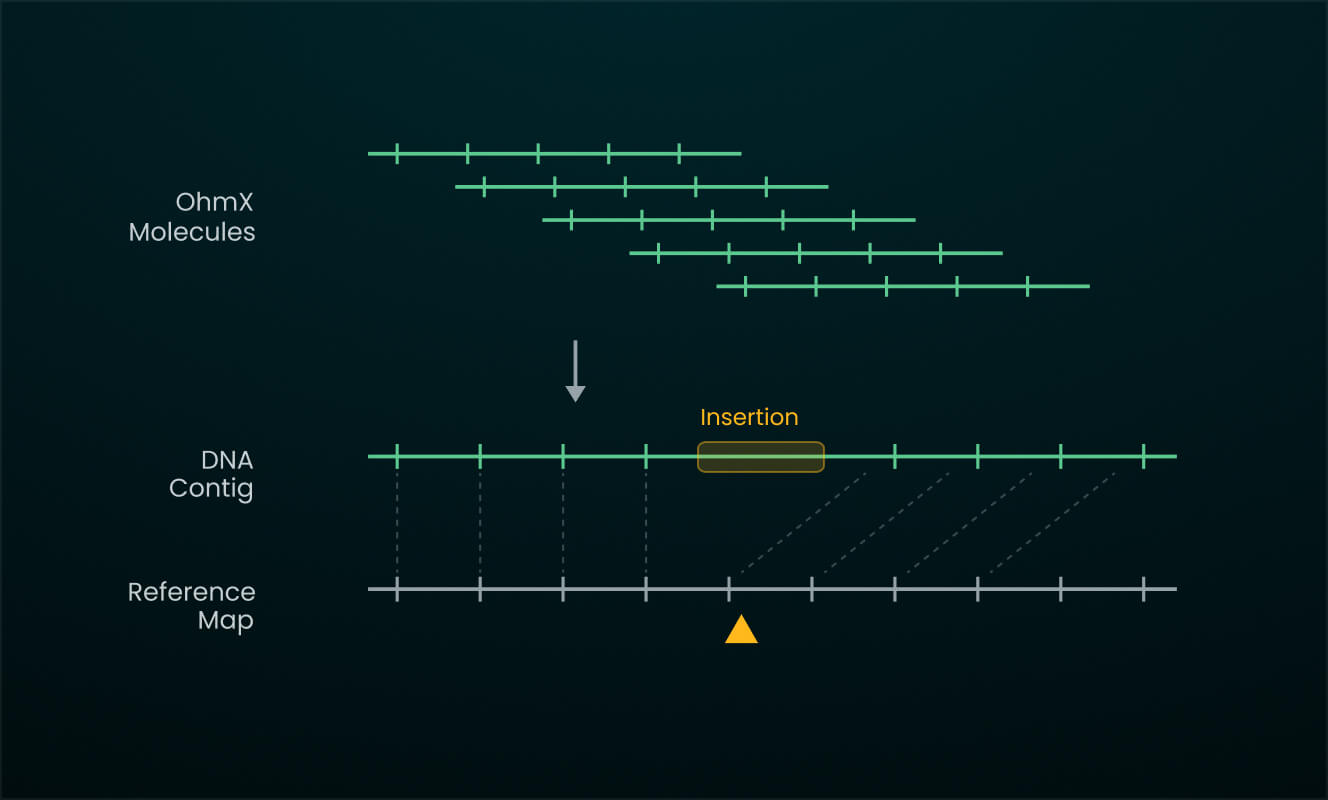
De novo assembly and structural variant calling down to 300 bp, to power genome-wide variant discovery.
SV-Verify™
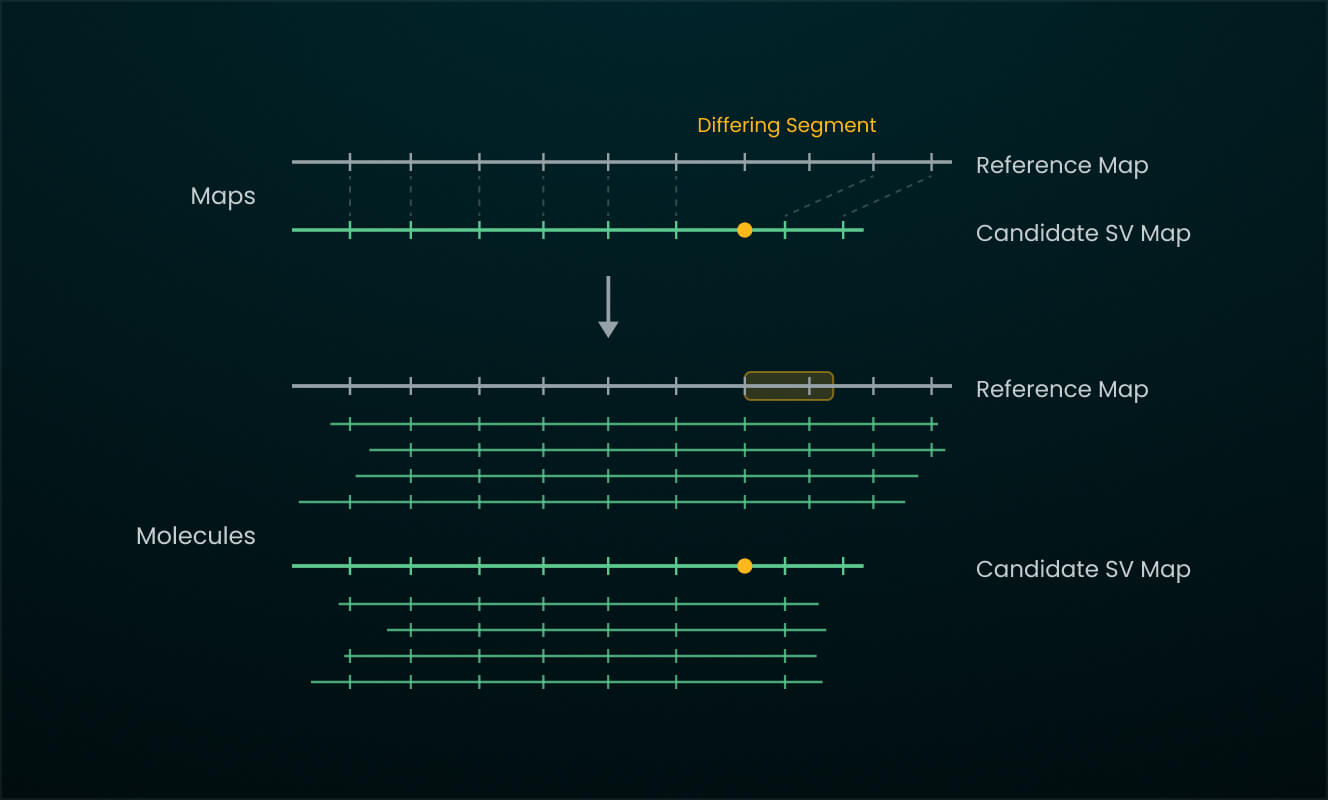
Independently confirm structural variants from your genome mapping or sequencing methods to provide confidence in your findings.
RepX™
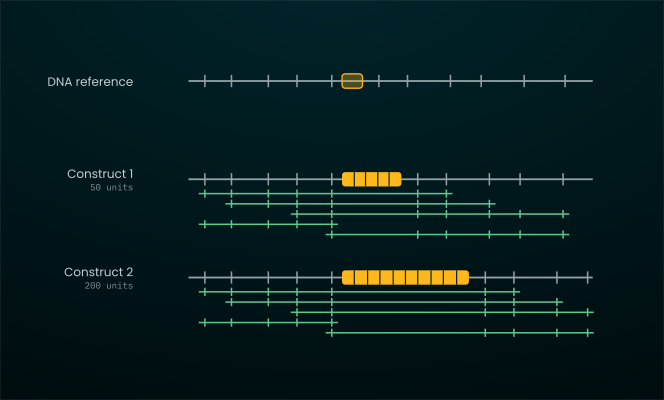
Build candidate repeat constructs, align molecules to the matching length, and report repeat count and length with confidence across diverse loci and cohorts.
Applications
Nabsys Navigator brings the analysis software together in a single environment, allowing users to focus on their research areas and address hypotheses.




Every Class of Structural Variant
Insertions, deletions, duplications, inversions, and translocations. Balanced events included, down to 300 bp and genome-wide.
Deletions
A genomic segment is absent from the sample. The interval between the flanking labels is shorter than reference by the size of the deletion, and any recognition site within the deleted segment produces no label on the contig.

Insertions
Additional sequence is present relative to reference. The interval between the flanking labels exceeds the reference interval by the length of the insertion; a recognition site carried within it appears as an additional label.

Duplications
A segment is present in more than one copy. In a tandem duplication the label pattern of that segment recurs in direct succession, and the region exceeds reference by the length of the duplicated segment.

Inversions
A segment is present in reverse orientation. Label order within the inverted interval is reversed relative to reference while the flanking labels are unchanged, so interval length is preserved. Inversions are balanced and carry no copy-number change.

Translocations
Segments from two non-homologous loci are joined. Beyond the breakpoint the contig carries the label pattern of the partner locus. Reciprocal translocations are balanced and are not detectable by copy-number methods.

Go Deeper into the Data
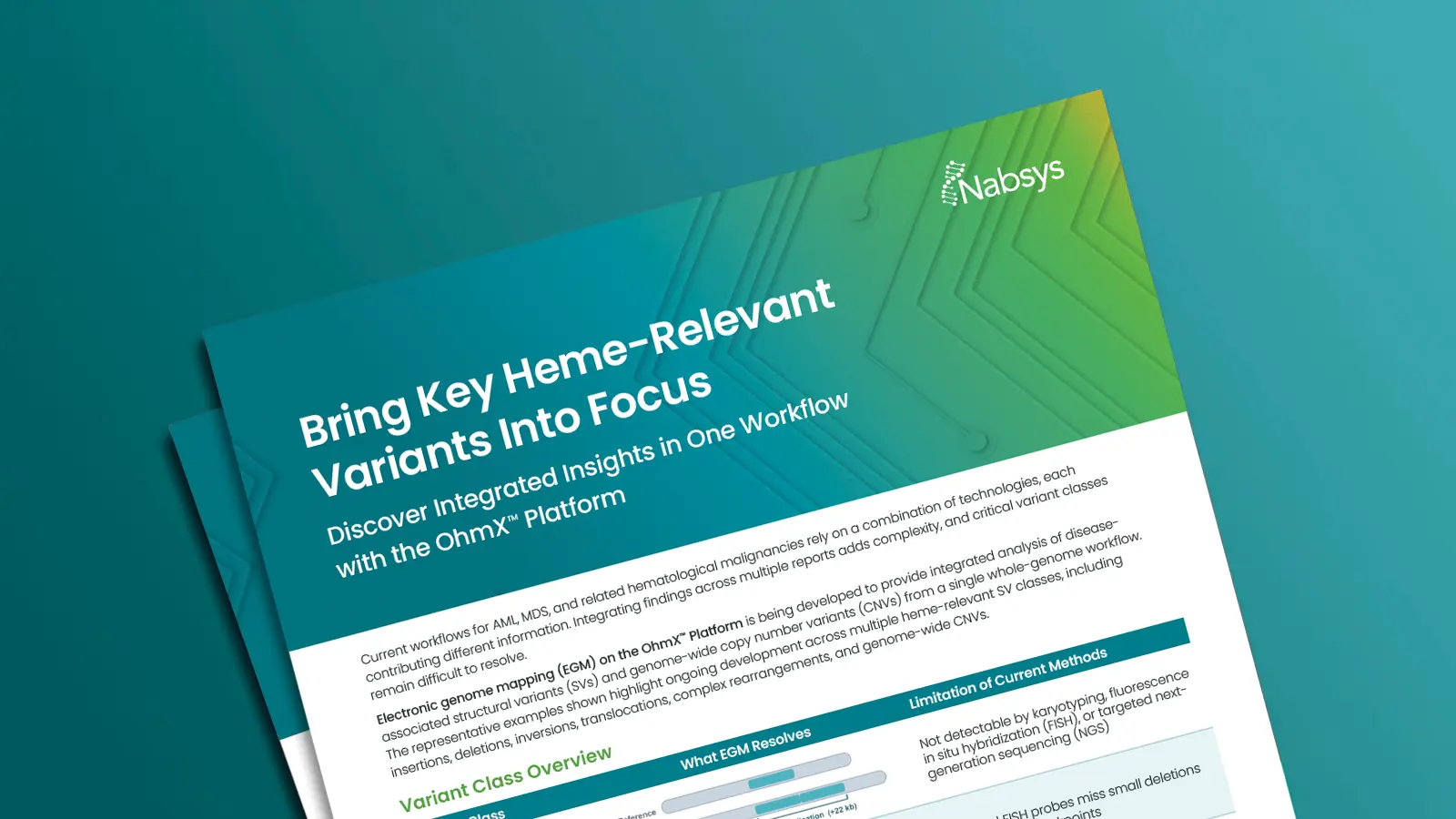
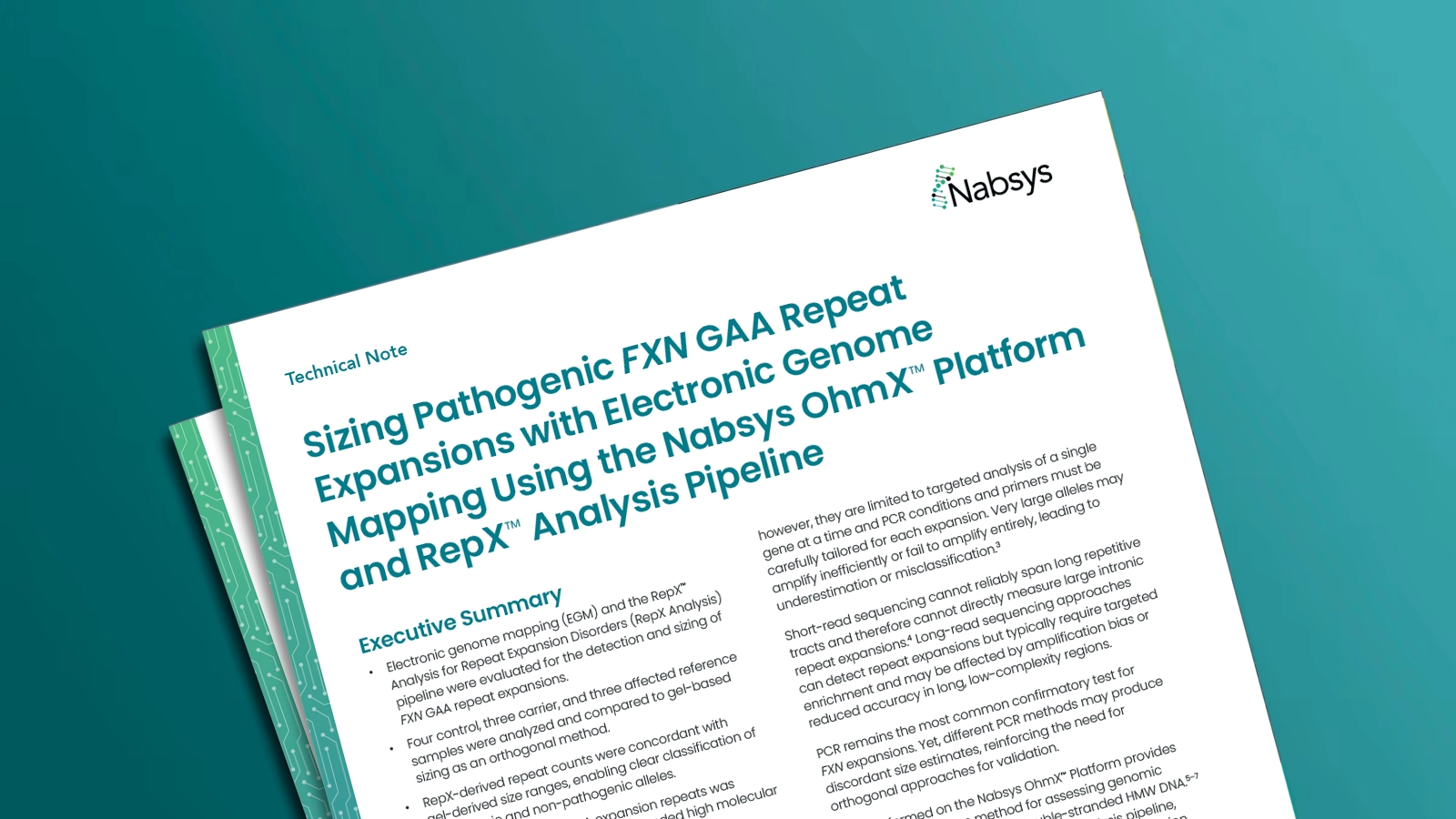
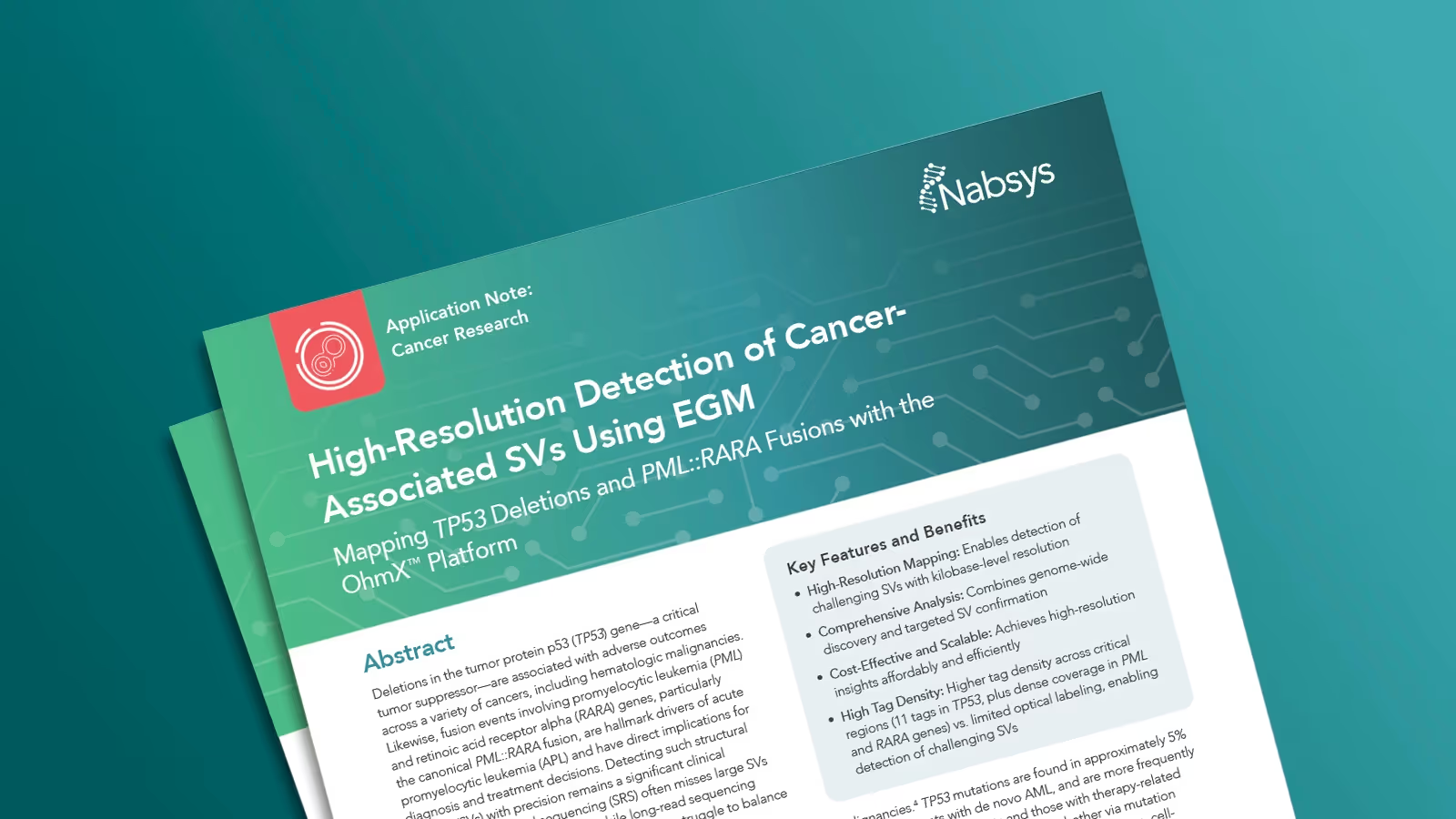
Explore more about the OhmX Platform through the resource gallery
Common Questions About Nabsys Navigator
01Subtitle
Yes. SV-Verify independently confirms structural variants called by other genome mapping or sequencing methods, aligning your prepared sample against a defined set of candidate variants. It is designed for resolving uncertain calls from short- and long-read sequencing and for orthogonal confirmation of cytogenetic findings.
01Subtitle
Secondary analysis runs in the cloud, where molecule maps are assembled, aligned, and used to call structural variants. Navigator is built on a cloud security and compliance architecture.
01Subtitle
Minimal bioinformatics expertise is required. The pipelines are prebuilt and the environment is a web interface, so there is no local pipeline to build and no hardware to provision.
01Subtitle
The cloud software behind the OhmX Platform. It turns electronic genome mapping data into a reviewed set of structural variant calls, powering whole-genome variant discovery and targeted variant verification through a suite of advanced informatics pipelines, in one web interface.