
Software & Analysis
Where millions of single-molecule maps hold answers to your next structural variant discoveries.
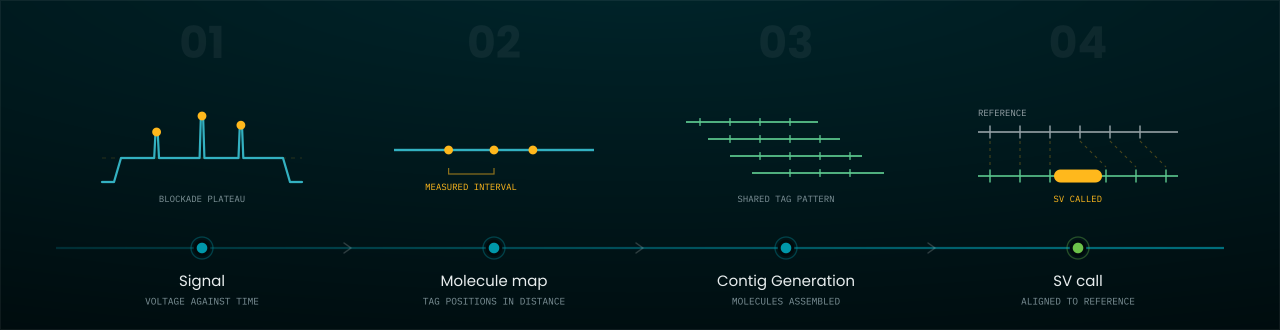
From Signal to Structural Variant
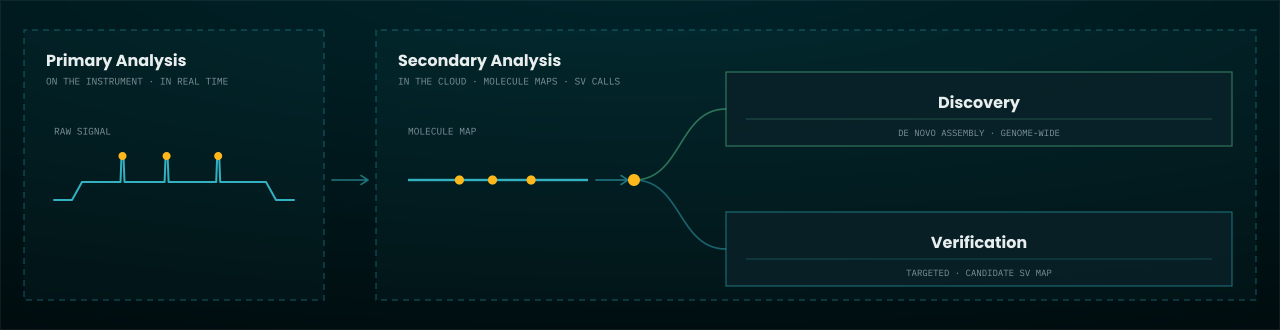
Analysis happens in two stages. Primary analysis converts raw electronic signal into single-molecule maps in real time during the run. Secondary analysis takes those maps and either assembles them to discover structural variants genome-wide, or aligns them against a defined set of candidate variants to confirm or reject each one.
One Cloud Environment with Nabsys Navigator
Genome maps deliver two ways to look at your data.
Primary Analysis
The instrument reads voltage as each molecule transits, producing the raw signal in real time as the run proceeds.
Secondary Analysis
In the cloud, those traces become distance-annotated molecule maps. The maps are then assembled and used to call structural variants, either genome-wide without a prior hypothesis or targeted against a defined set of candidates.
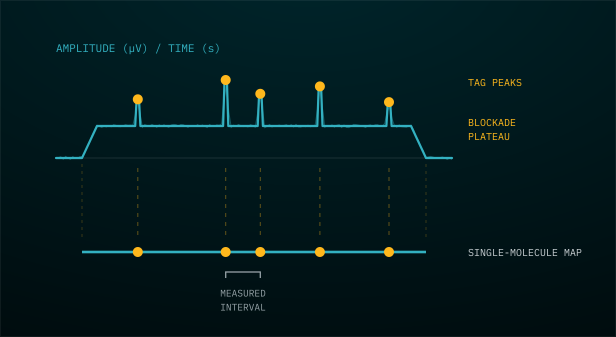
What the Instrument Produces in Real Time
What Happens During the Run
Voltage-versus-time traces from all 256 channels are processed as the run proceeds. Transit times become physical distances, and each molecule that passes through a nanochannel emerges as a portion of a genome map.
Why It Runs in Real Time
Sample quality shows up in the metrics immediately, so a run that will not yield usable data can be identified early rather than after collection finishes. Molecule length distribution, tag density, and coverage are all visible while the run is still in progress.
How a Structural Variant is Called
A Difference in Intervals is the Variant
Assemble
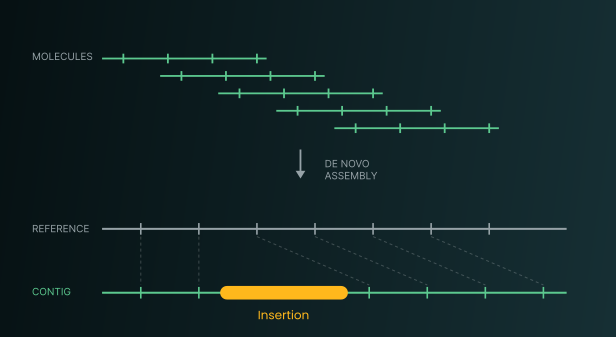
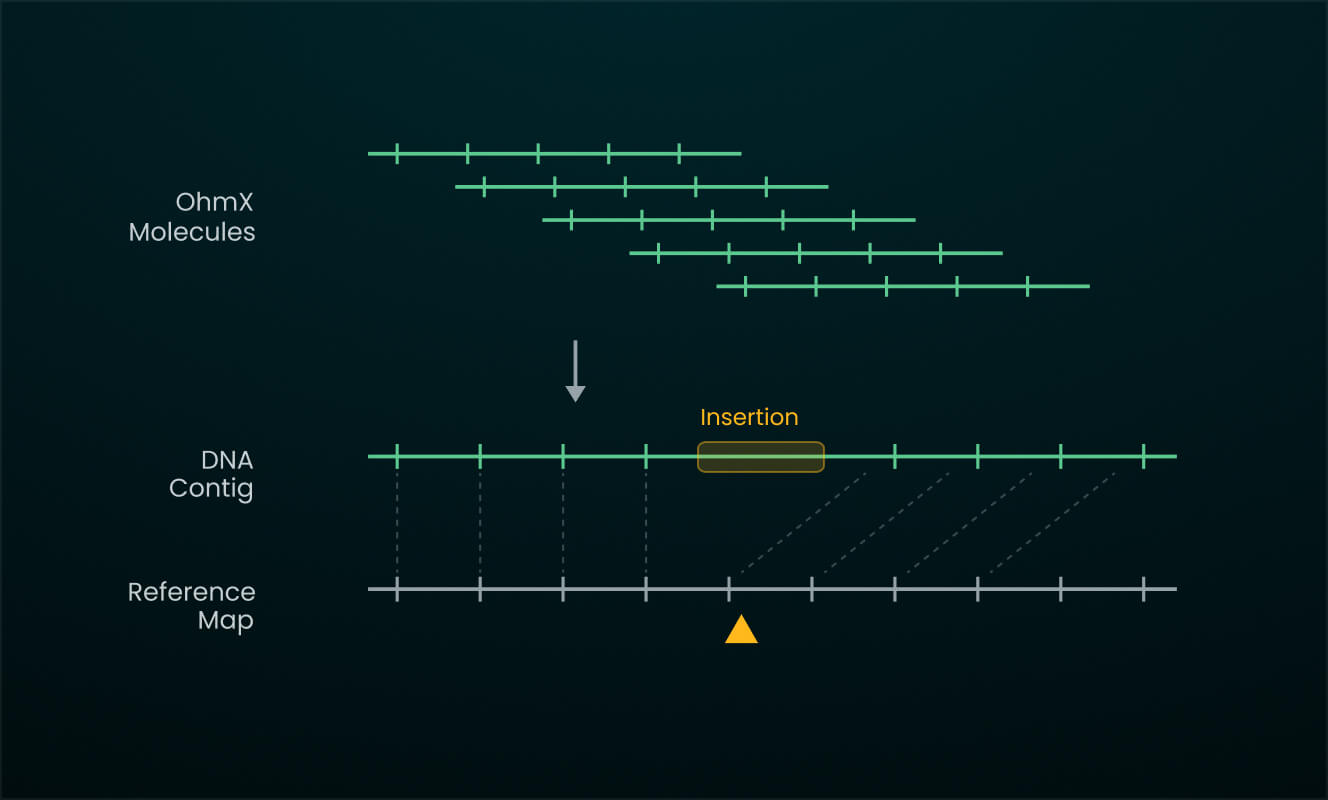
Overlapping single-molecule maps are assembled de novo into map contigs, which carry far more confidence than any individual molecule.
Align
Contigs are aligned to a chosen human reference, GRCh37 or GRCh38.
Compare
Where a tag in the sample sits at a different position than the reference predicts, the interval between tags has changed. The size and direction of that change identify the variant and its type.
Call
Insertions, deletions, duplications, inversions, and translocations are reported with size and genomic location, then filtered and compared against published and proprietary datasets.
Discover or Verify in the Same Place
Nabsys Navigator supports both modes of structural variant (SV) analysis, so one environment covers the whole question.
What SVs Are Present?
Genome-wide, assembly-based calling across the genome, without a prior hypothesis.
Use when the causal variant is unknown, or the goal is a complete genome assessment.
Are These Specific SVs Present?
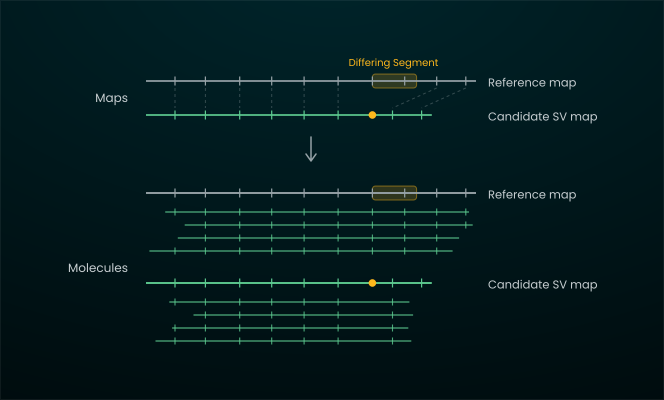
Targeted and alignment-based against a defined variant panel. Quickly get answers if specific SVs are in your dataset.
Use when confirming calls from other cytogenetic or genomic technologies.
Every Class of Structural Variant
Insertions, deletions, duplications, inversions, and translocations. Balanced events included, down to 300 bp and genome-wide.
Deletion
A genomic segment is absent from the sample. The interval between the flanking labels is shorter than reference by the size of the deletion, and any recognition site within the deleted segment produces no label on the contig.

Insertion
Additional sequence is present relative to reference. The interval between the flanking labels exceeds the reference interval by the length of the insertion; a recognition site carried within it appears as an additional label.

Duplication
A segment is present in more than one copy. In a tandem duplication the label pattern of that segment recurs in direct succession, and the region exceeds reference by the length of the duplicated segment.

Inversion
A segment is present in reverse orientation. Label order within the inverted interval is reversed relative to reference while the flanking labels are unchanged, so interval length is preserved. Inversions are balanced and carry no copy-number change.

Translocation
Segments from two non-homologous loci are joined. Beyond the breakpoint the contig carries the label pattern of the partner locus. Reciprocal translocations are balanced and are not detectable by copy-number methods.

Analysis Runs in Nabsys Navigator™
Everything happens in one cloud environment. No local pipeline to build, no hardware to provision, and no bioinformatics team required to get from a run to a structural variant call.

Go Deeper into the Data
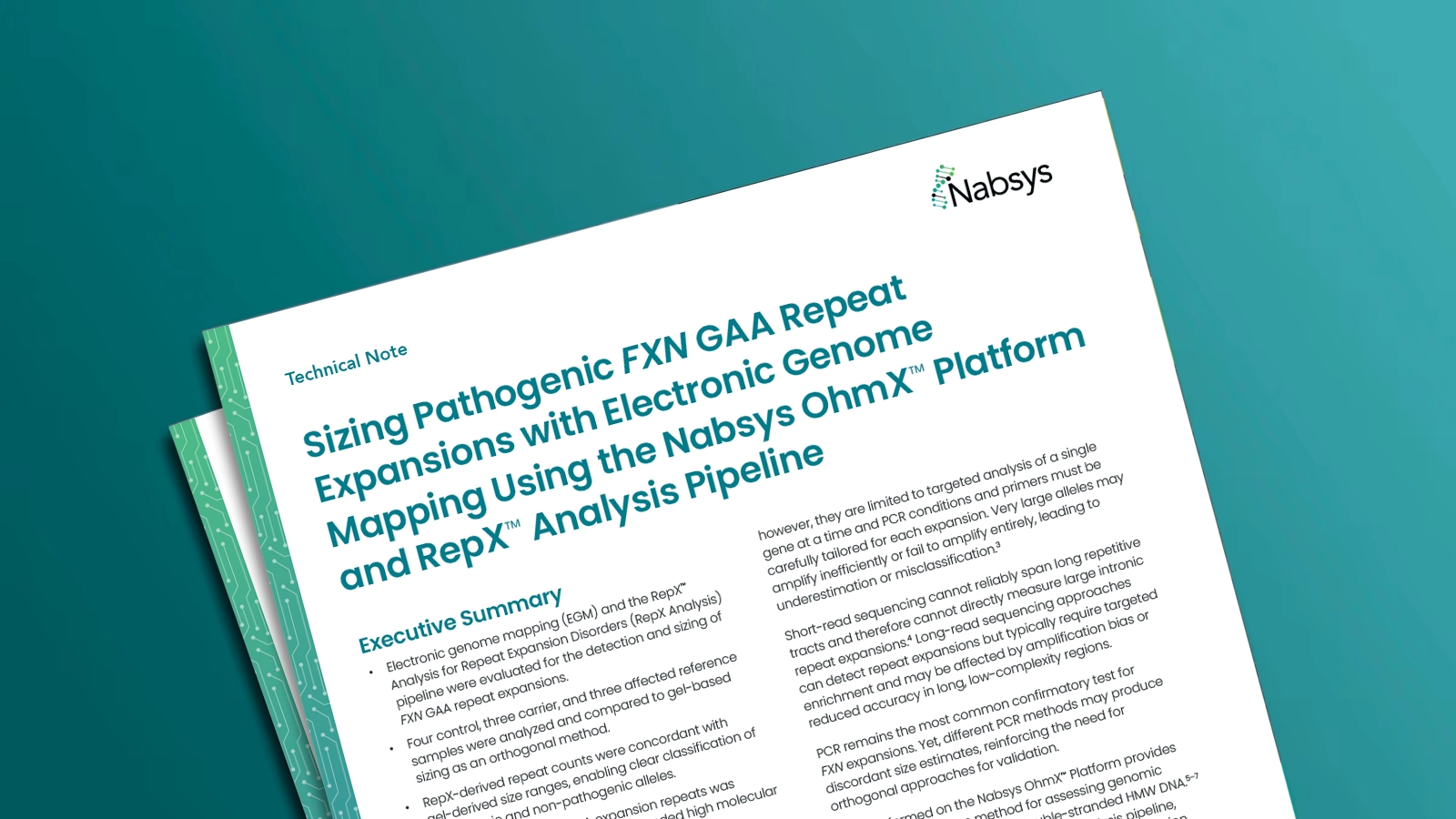
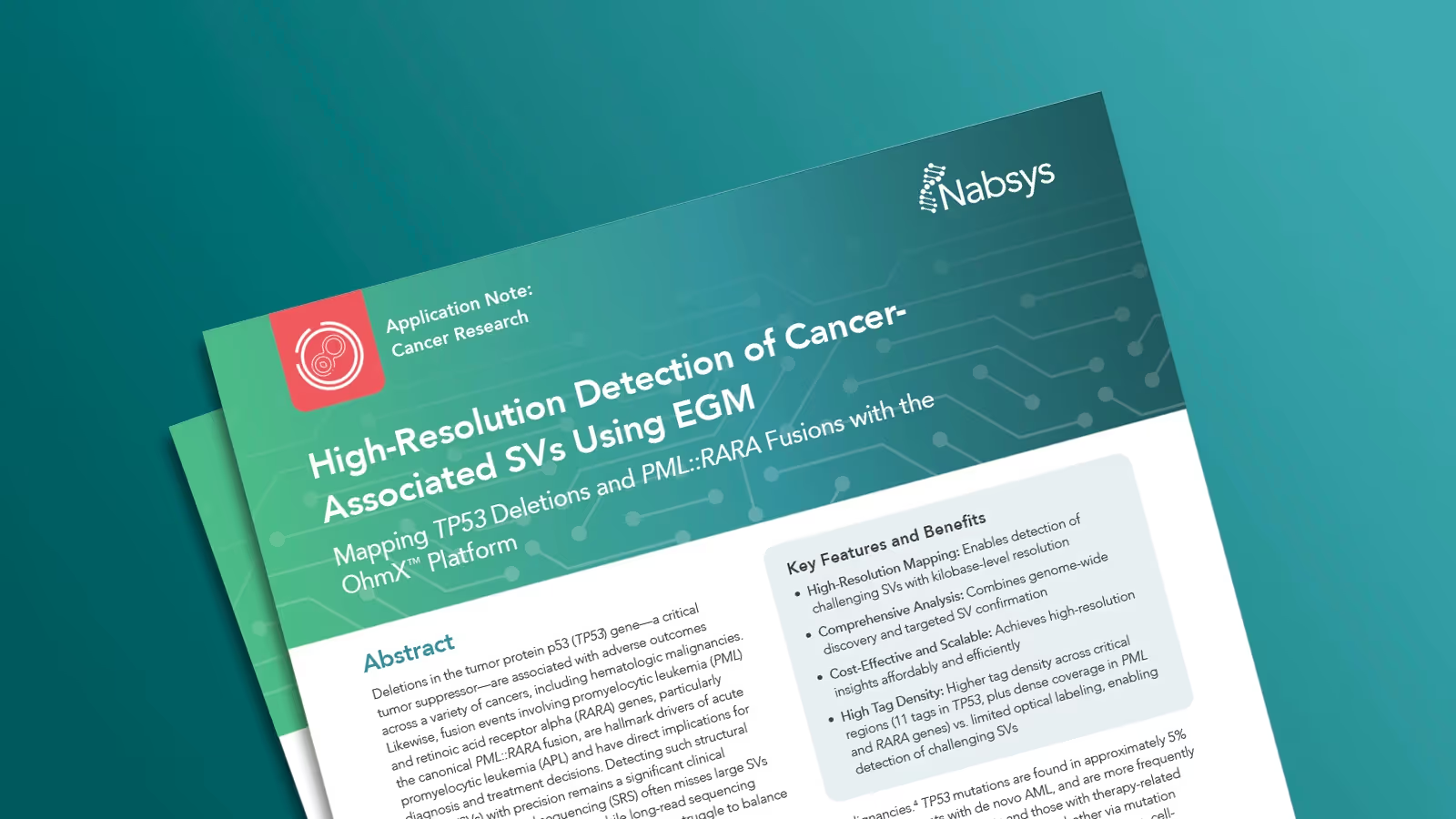
Explore more about the OhmX Platform through these supplementary resources.

Common Questions About Software & Analysis
01Subtitle
Yes. Findings can be summarized and exported as shareable outputs for a team or a publication, and the variant list can be filtered and exported directly from the interface.
01Subtitle
Both, in sequence. Primary analysis happens on the instrument in real time, where voltage-versus-time traces from all 256 channels become single-molecule maps as the run proceeds. Secondary analysis happens in the cloud, where those maps are assembled, aligned, and used to call structural variants.
01Subtitle
No. There is no local pipeline to build, no hardware to provision, and only minimal bioinformatics experience is required. Analysis runs through prebuilt informatics pipelines in Nabsys Navigator, accessed through a web interface.
01Subtitle
SV-Discover is genome-wide and assembly-based. Use it when the causal variant is unknown or the goal is a complete genome assessment. SV-Verify is targeted and alignment-based against a defined variant panel. Use it to confirm calls from other cytogenetic or genomic technologies. Both run on the same prepared sample and the same instrument. The question you are asking decides the path.
01Subtitle
Assembled map contigs are aligned to GRCh37 or GRCh38.