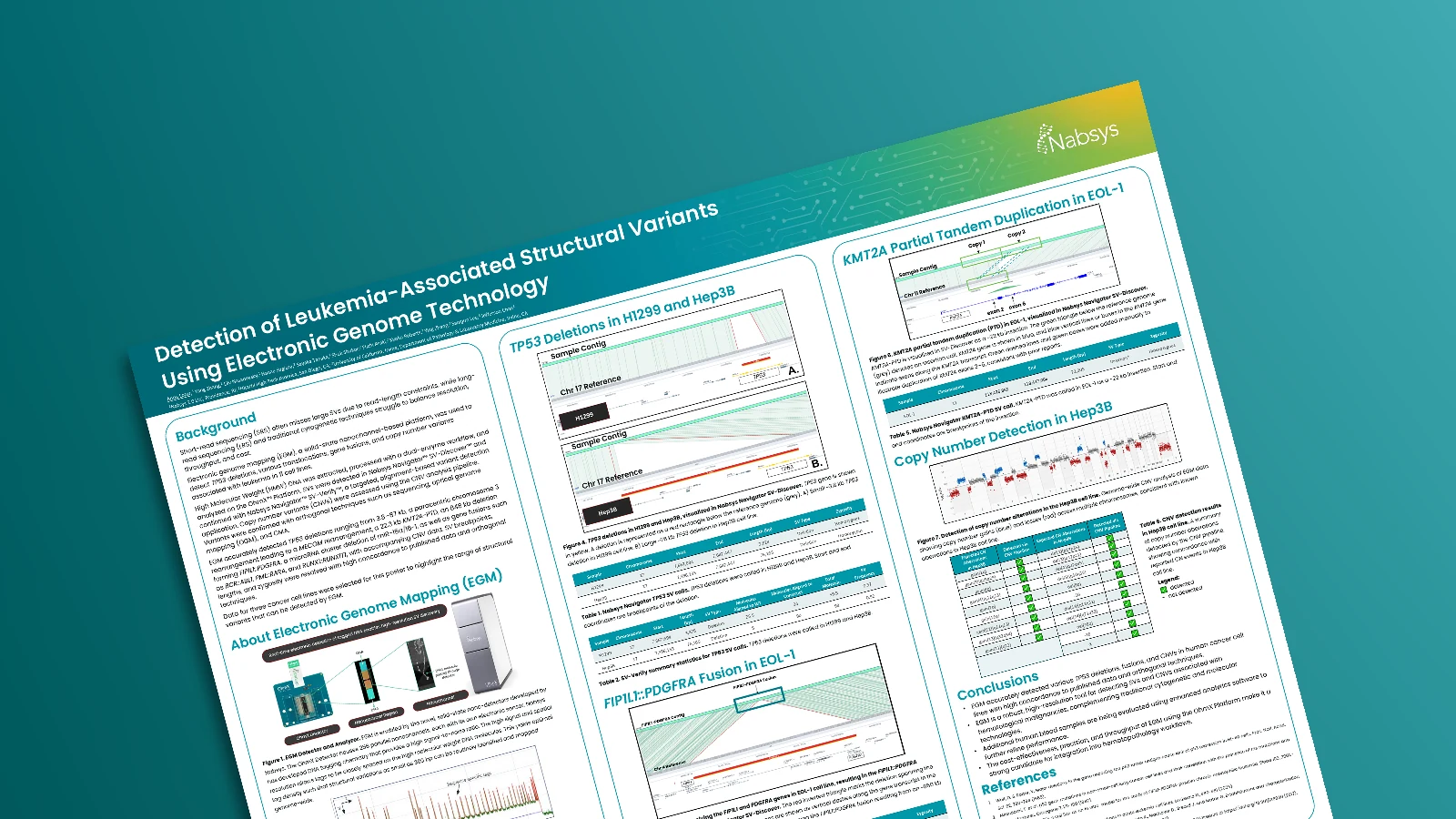
Detection of Leukemia-Associated Structural Variants Using Electronic Genome Technology

Short-read sequencing often misses large structural variants (SVs), while long-read sequencing and traditional cytogenetic methods struggle to balance resolution, throughput, and cost. This study examined whether electronic genome mapping (EGM) could resolve the deletions, gene fusions, and copy number changes associated with leukemia in well-characterized cell lines.
High molecular weight DNA was analyzed on the OhmX™ Platform. SVs were detected with SV-Discover™ and confirmed with SV-Verify™, both available in Nabsys Navigator™, and copy number variants (CNVs) were assessed with the CNV analysis pipeline. The poster highlights homozygous TP53 deletions of ~3.8 kb and ~76 kb in the H1299 and Hep3B cell lines, an ~848 kb deletion forming the FIP1L1::PDGFRA fusion and a ~22 kb KMT2A-PTD in the EOL-1 eosinophilic leukemia cell line, and genome-wide copy number changes in Hep3B concordant with its reported aberrations. Breakpoints, lengths, and zygosity were concordant with published data and orthogonal methods.
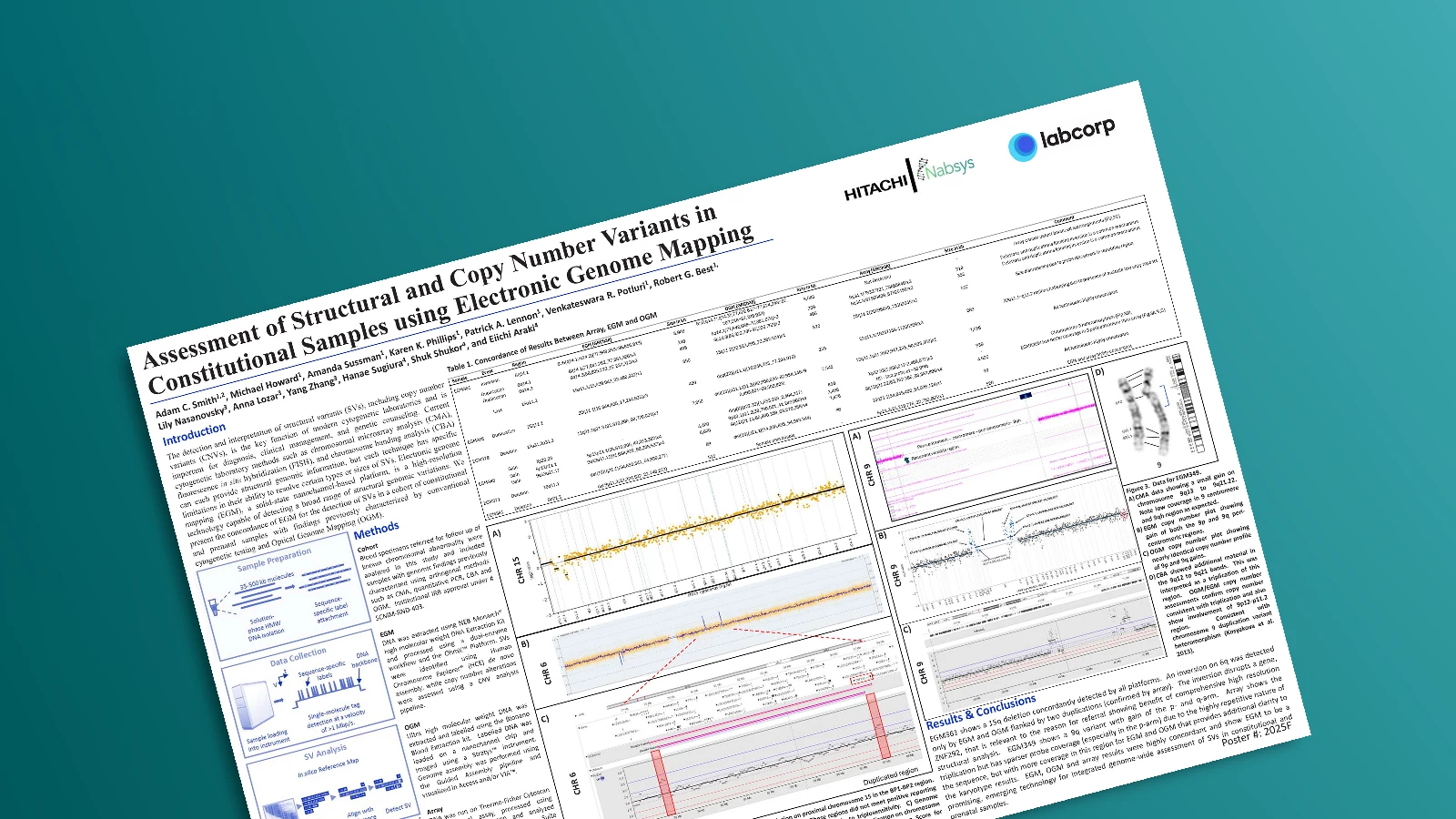
Explore how EGM complements sequencing, optical genome mapping, and cytogenetic methods to power high-resolution SV and CNV detection in your hematologic malignancy research.
Download Now